AI Model Rankings and Agent Harnesses in September 2026
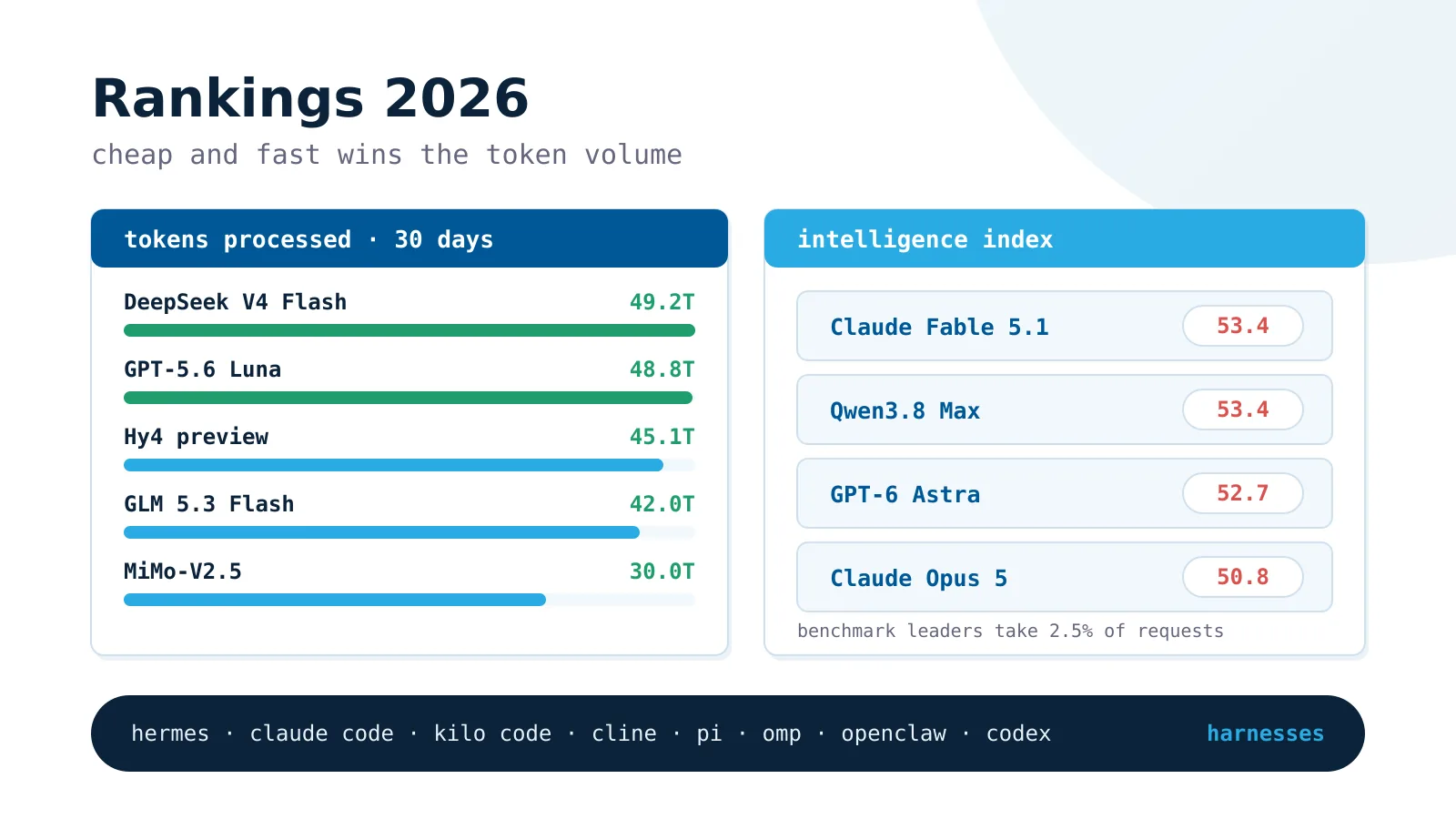
The AI market has split in two. Cheap, fast models take almost all the token volume, while the models that win benchmarks take a small slice of real traffic.
Token Volume Goes to Flash Models
The monthly leaderboard counts prompt and completion tokens routed through one API. Seven of the top ten entries are budget or “flash” variants.
| # | Model | Author | Tokens (30 d) | Change |
|---|---|---|---|---|
| 1 | DeepSeek V4 Flash 0731 | deepseek | 49.2T | +74% |
| 2 | GPT-5.6 Luna | openai | 48.8T | +215% |
| 3 | Hy4 preview | tencent | 45.1T | new |
| 4 | GLM 5.3 Flash | z-ai | 42T | new |
| 5 | MiMo-V2.5 | xiaomi | 30T | +5% |
| 6 | Ox Alpha | stealth | 27.2T | >999% |
| 7 | Hy3 | tencent | 21.3T | -33% |
| 8 | DeepSeek V4 Flash 0423 | deepseek | 20.4T | -21% |
| 9 | Nemotron 3 Ultra (free) | nvidia | 18.5T | +63% |
| 10 | DeepSeek V4.1 Flash | deepseek | 18.2T | new |
Two names stand out. Ox Alpha is a stealth model with no public vendor, and it still moved 27.2T tokens. Tencent arrived from nowhere with two entries.
Benchmarks Rank a Different Set
The Artificial Analysis Intelligence Index puts a completely different group on top.
| # | Model | Score |
|---|---|---|
| 1 | Claude Fable 5.1 | 53.4 |
| 2 | Qwen3.8 Max | 53.4 |
| 3 | GPT-6 Astra (max) | 52.7 |
| 4 | Claude Opus 5 | 50.8 |
| 5 | Claude Fable 5 | 49.6 |
Anthropic holds three of the five best scores. Anthropic also holds 2.5% of weekly requests. That gap is the whole story of this market: intelligence sells licences, price sells tokens.
Who Holds the Market
Request share by model author, week of 7 September:
- openai 23.6% (+28%), the biggest single author,
- deepseek 22.6% (+3%), nearly level on requests and ahead on tokens,
- google 18.6% (+2%), steady,
- tencent 7.2% (+105%), the fastest climber,
- z-ai 7.0% (-22%), losing share after the GLM 5.3 launch,
- anthropic 2.5% (-5%), small on volume, top on quality.
Speed Matters More Than Peak Intelligence
Agent runs are not one prompt. A single task means dozens of sequential tool calls, and each call waits for the previous one. Latency multiplies across a session, so a model twice as fast finishes the job in half the wall clock time.
Price multiplies the same way. I described that bill in how I lost 900 PLN on Gemini API tokens. Flash-class models cost a fraction per million tokens, which is why harness authors set them as the default and reserve frontier models for hard steps.
Which Models Agent Harnesses Actually Run
Each harness reports its own model mix. The pattern repeats across all of them.
| Harness | Top three models this month |
|---|---|
| Hermes Agent | DeepSeek V4 Flash 0731, GLM 5.3 Flash, Ox Alpha |
| Claude Code | GLM 5.3 Flash, Ox Alpha, GLM 5.3 |
| Kilo Code | Laguna S 2.1, Nemotron 3 Ultra, MiniMax M3 |
| Cline | GLM 5.3 Flash, DeepSeek V4 Flash 0731, Muse Spark 1.3 |
| pi | GLM 5.3 Flash, DeepSeek V4 Flash 0731, DeepSeek V4.1 Flash |
| omp | Ox Alpha, GLM 5.3 Flash, DeepSeek V4.1 Flash |
| DeepSeek Harness | Ox Alpha, DeepSeek V4 Flash 0731, GLM 5.3 Flash |
| OpenClaw | DeepSeek V4 Flash 0731, DeepSeek V4 Flash 0423, GLM 5.3 Flash |
| Codex | GPT-5.6 Sol, GPT-5.6 Luna, GPT-6 Astra |
Three findings come out of that table. DeepSeek V4 Flash, GLM 5.3 Flash and Ox Alpha are the shared default of the whole field. Codex is the only harness running a single vendor. And Claude Code users on this router mostly buy GLM tokens, not Claude tokens.
The Ten Biggest Apps and Agents
Ranked by tokens on the most recent full day.
1. Hermes Agent, 1.49T
An open-source, self-improving agent from Nous Research. It keeps memory across sessions, builds reusable skills, and ships 40+ tools including browser automation and vision. It ranks first in productivity, coding and personal agents at once, across 469 models.
Pro: one agent covers coding and daily automation, with persistent memory. Con: persistent memory and 40+ tools mean a wide attack surface and a large standing context.
2. Claude Code, 917B
Anthropic’s terminal coding agent. It reads the whole codebase, plans edits across files, runs tests and iterates on failures. Active since December 2025, 373 models used.
Pro: the most mature planning loop and test-fix cycle in the field. Con: the CLI is closed source, and model routing outside Anthropic needs a workaround.
3. Kilo Code, 568B
An open-source coding agent for VS Code, JetBrains and the terminal. It is the number one IDE extension by tokens and has run since April 2025.
Pro: widest editor coverage, so the team keeps its existing tools. Con: its model mix leans on niche vendors such as poolside and dots-studio, which is a bet on their availability.
4. Cline, 395B
An open-source agent that lives inside the IDE, explores the codebase, edits files, runs terminal commands and drives a browser. The oldest entry here, active since October 2024.
Pro: the longest track record and browser automation built in. Con: the IDE-only model makes headless and CI use awkward.
5. pi, 299B
A CLI coding agent branded around personal configuration, live since February 2026 and already 8.12T tokens total.
Pro: balanced model mix, so no single vendor outage stops work. Con: young project with thin public documentation, so the roadmap is hard to judge.
6. omp, 200B
A CLI coding agent that appeared in May 2026 and went straight into the top ten, with Ox Alpha as its largest model.
Pro: fast growth and heavy use of the cheapest fast models. Con: the site publishes almost nothing, and its top model is a stealth model with no vendor to call.
7. OpenClaw, 163B
An open-source personal agent that plugs into messaging apps, runs commands, browses the web, handles files and sends email. Second in productivity and personal agents.
Pro: you drive real actions from a chat window, with no IDE. Con: command execution from a messaging app is the riskiest setup on this list.
8. DeepSeek Harness, 150B
DeepSeek’s own harness, on GitHub since August 2026. Almost all traffic goes to Ox Alpha and DeepSeek Flash builds.
Pro: tuned by the model vendor, so tool calling matches the model. Con: clear single-vendor bias, and no product documentation beyond the repository.
9. Codex, 128B
OpenAI’s coding agent. Its top five models are all OpenAI, which no other harness does.
Pro: deep integration with GPT-5.6 and GPT-6 reasoning modes. Con: full vendor lock, so you cannot cut cost by switching to a cheap model.
10. ISEKAI ZERO, 65.7B
The only non-coding app in the top ten. An interactive fiction platform, first in entertainment, running on 49 models only.
Pro: proof that roleplay still funds a serious share of inference. Con: irrelevant to engineering work, and a narrow model pool.
Why opencode Is Missing From That List
One absence surprises me: opencode does not show up in the top ten, even though I run it daily and it competes directly with Claude Code and Cline. The ranking data does not explain the gap, so what follows are my assumptions.
- tracking is opt-in: an app appears only when it sends attribution headers, and private requests are dropped before aggregation,
- the router is optional: opencode talks to Anthropic, OpenAI, GitHub Copilot and local models directly, so subscription traffic never passes OpenRouter,
- subscriptions beat per-token billing: a developer on a flat Claude or Copilot plan has no reason to route the same work through a pay-per-token API,
- attribution splits: custom titles and self-built configs land as separate small entries instead of one aggregated name,
- the bar is high: tenth place needed 65.7B tokens in a day, so a tool can be popular with developers and still miss the cut.
None of that says opencode is small. The leaderboard counts router traffic, not installs, and a harness that lets you bring any provider will always under-report there.
What to Take From These Numbers
Set a Flash-class model as the default and escalate to a frontier model only for planning and hard debugging. That split is what the leading harnesses already do.
Pick a harness that lets you change models. Eight of the ten do, and vendor lock is the one cost you cannot renegotiate later. My reasoning on frameworks that keep agent context short sits in why Laravel, Yii and Rails suit agent driven development.
One caveat: these rankings measure adoption on one router, not quality and not the whole market. A model that produces more tokens is not a better model, it is a more verbose or more popular one.
Data Source
All numbers in this article come from OpenRouter rankings, usage data through 19 September 2026, published under CC BY 4.0.