BigQuery Graph Is Now Generally Available
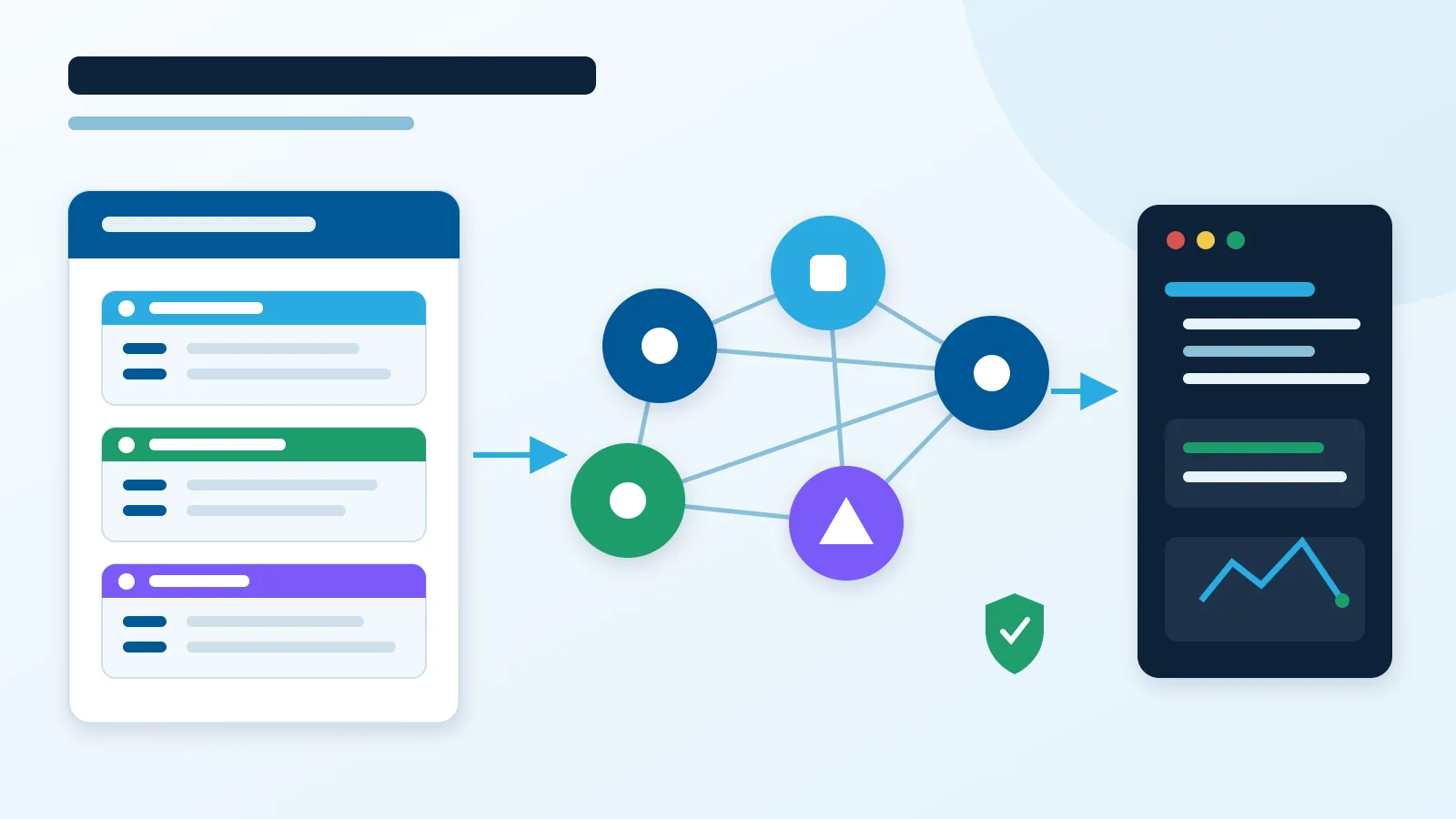
BigQuery Graph is now generally available. You turn your existing tables into nodes and edges, then query them in GQL directly inside BigQuery. No separate graph database. No data export.
Google announced general availability on September 1, 2026. The data stays where it is and remains subject to the rules you have already set.
What the property graph mirrors
A property graph works on the tables you already have. It consists of three elements:
- node tables — people, devices, products, suppliers;
- edge tables — a purchase, a login, a transfer, a contract;
- labels and properties — the types and fields visible to your patterns.
Graph steps and SQL run in one query. In the same flow you can also call BigQuery ML and AI functions.
Row- and column-level security still applies. This detail matters when a path could reveal a connection through data the analyst cannot access.
When GQL beats a join
Joins work well when you know the path and the number of steps. They get painful when the route is unknown.
Ask how two accounts connect. Ask which services depend on a broken part. Ask whether money finds its way back to where it started. GQL writes such questions as patterns.
The GA release added the CALL statement and broader support for graph subqueries. Data engineers can publish small, proven operations instead of one big pattern per case.
Test the performance claims yourself
Google reports that GQL runs twice as fast as in preview, and undirected traversals up to a hundred times faster. Those are vendor benchmarks, not a capacity plan.
Run four queries before you believe the numbers:
| Test | What it shows |
|---|---|
| Bounded neighbourhood | The cost of plain interactive reads |
| Undirected path | The gain on the slowest traversal type |
| Cycle search | How the ACYCLIC and TRAIL modes behave |
| Worst multi-step query | The real production ceiling |
Record the bytes scanned and slot usage, not just the time. A fast traversal is still expensive if every request scans a poorly bounded graph.
A safe first project
Pick one small domain: account-to-device links, service dependencies, or a supplier chain. Then follow five steps:
- Find stable node keys and clear source and target keys for edges.
- Build the graph on your existing tables, not on copies.
- First reproduce a known result from SQL.
- Test access on a restricted account, not an administrator.
- Bound interactive traversals and watch cost and latency.
Model quality beats clever queries. One shared IP address is a weak signal. Repeated use of the same verified device is stronger. Storing both cases as a fuzzy RELATED_TO edge destroys trust in the results.
Graph context for AI agents
Google also promotes BigQuery Graph as ground for agents and GraphRAG workflows. An answer can carry the path it was reached by, which helps an audit.
That path does not make the answer correct. Generated GQL still needs review, and permissions still apply on the source data.
Read the fine print: only BigQuery Graph itself has GA status. Conversational exploration, MCP tools, and cross-cloud access may remain in preview. Check the status in your own project.