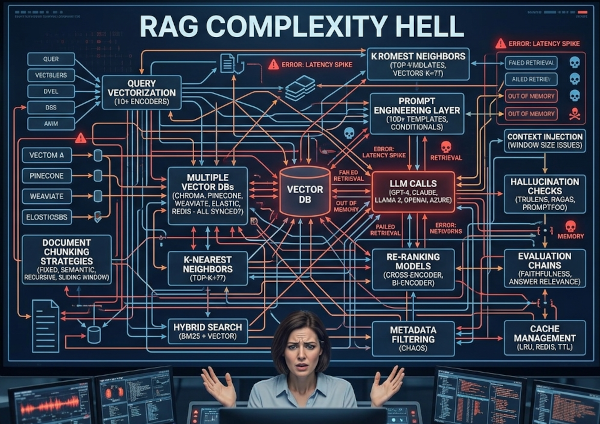
Retrieval-Augmented Generation (RAG) promises to combine external knowledge sources with the capabilities of large language models. In theory, the concept is simple: retrieve the right information, provide it to the model, and generate an answer. In practice, many implementations fail to deliver the expected results.
The problem is rarely the model itself. It is rarely the vector database either. More often than not, the real issue is unnecessary complexity.
One of the most important lessons learned from projects delivered by PCEUROPA is remarkably simple:
If a solution becomes too complex, it will rarely achieve its intended goal. It becomes harder to maintain, more expensive to operate, more difficult to understand, and eventually gets outperformed by simpler and more predictable alternatives.
This principle applies especially well to RAG systems.
Anti-Patterns – RAG complexity hell
Mechanical Text Chunking
Splitting documents into fixed-size chunks of 500, 1,000, or 2,000 characters is one of the most common mistakes.
This approach breaks sentences, destroys relationships between paragraphs, and often fragments tables or structured content. As a result, the model receives pieces of information that have lost their original meaning.
Chunks should be driven by document structure, not arbitrary character counts.
Treating PDFs as Plain Text
A PDF is not a text file.
It contains structure, headings, sections, tables, charts, and spatial relationships. Flattening everything into a single stream of text destroys valuable information before indexing even begins.
Blind Trust in Embeddings
Vector databases are not magic. Embeddings are excellent at finding semantic similarity, but they do not always understand distinctions that matter in real-world business scenarios. In domains such as law, finance, healthcare, or technical documentation, small retrieval errors can lead to completely incorrect answers.
Delegating Responsibility to the Model
LLMs do not verify facts. If inaccurate or conflicting information is provided in the context, the model will treat it as valid input and generate answers accordingly.
The responsibility for correctness belongs to the system architecture and data pipeline, not to the language model.
Architectural Monsters
A common pattern is attempting to solve problems by adding more layers:
- a retrieval model,
- a ranking model,
- a correction model,
- a summarization model,
- a validation model.
Eventually, nobody understands why the system produced a particular answer.
If five models are required to compensate for the weaknesses of the first one, the actual problem probably exists elsewhere in the pipeline.
Framework-Driven Development
Frameworks such as LangChain and CrewAI are excellent for experimentation and rapid prototyping. Problems appear when production architectures are designed around frameworks instead of business requirements.
Over time, maintenance complexity, debugging challenges, and dependency management often become larger problems than the original business challenge.
Reindexing Everything
Increasing chunk sizes and rebuilding the entire vector database is often an attempt to treat symptoms rather than causes. If the underlying issue is poor data quality or a flawed retrieval strategy, reindexing simply reproduces the same problems at a larger scale.
Best Practices
Own the Context
The primary responsibility of a RAG system is to provide the model with the right context. Success is not determined by how much information is retrieved, but by how relevant, trustworthy, and complete that information is.
Good RAG systems optimize for context quality, not context volume.
Structure Over Size
Better results are achieved when preserving natural document structures:
- chapters,
- sections,
- paragraphs,
- tables,
- technical references,
- relationships between documents.
In practice, a smaller number of high-quality contextual units often outperforms thousands of arbitrary chunks.
Hybrid Retrieval
The most reliable systems combine multiple retrieval methods:
- semantic search
- keyword search
- graph search
- metadata filtering
Embeddings provide semantic understanding, while traditional search provides precision and determinism.
Neither approach should be expected to solve every problem alone.
Simplicity as an Architectural Principle
This may be the most important principle of all. Every component should answer a simple question:
What specific problem does this solve?
If the answer is unclear, the component is probably unnecessary.
Systems built from a few understandable and auditable components usually outperform architectures filled with agents, chains, orchestration layers, and abstraction frameworks.
Data Quality Over Model Selection
In most RAG projects, the largest performance gains do not come from replacing one language model with a newer one.
The greatest improvements usually come from:
- better source data,
- better metadata,
- cleaner document structures,
- stronger retrieval strategies,
- improved data governance.
Data is the product.
The model is merely a tool used to access it.
The PCEUROPA Principle
At PCEUROPA, one lesson repeatedly proves true across projects:
Simplicity scales better than complexity.
A system that can be understood, audited, monitored, and maintained by engineers years later has a significantly higher chance of long-term success than a system built around layers of hidden logic and increasingly sophisticated workarounds. Many teams focus on building smarter models. The most successful teams focus on building better systems.
Conclusion
The biggest mistake in RAG architecture is assuming that more sophistication automatically produces better outcomes.
Experience shows the opposite.
The most effective RAG systems are often surprisingly simple. They rely on high-quality data, transparent retrieval processes, and the minimum number of moving parts required to solve the problem.
The first rule of RAG should be:
If a solution becomes too complex, it is unlikely to survive long enough to achieve its goal. Simplicity is not a limitation. Simplicity is a competitive advantage.